
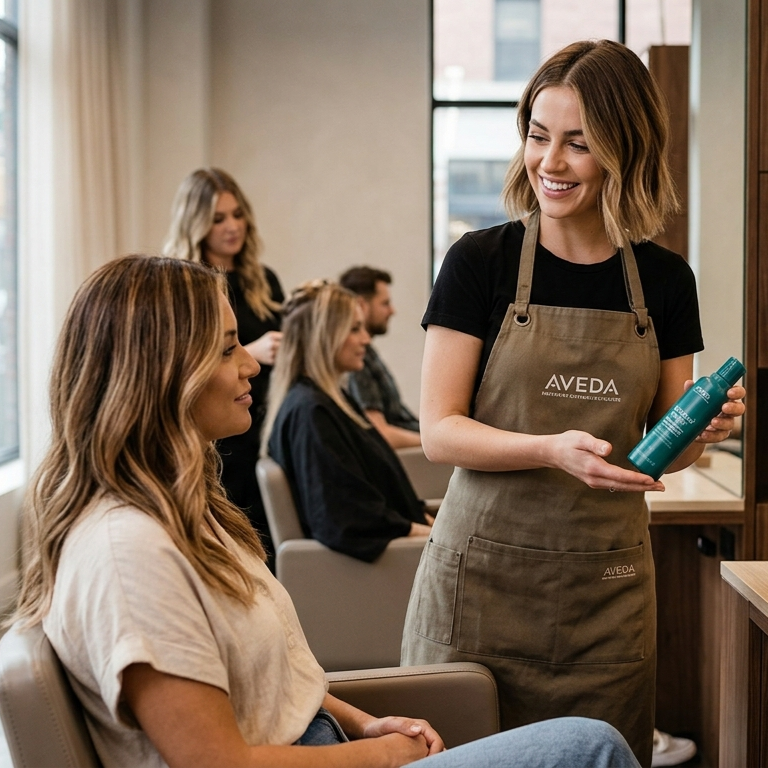
Retail sales for stylists carry a reputation problem in this industry. Specifically, many new professionals associate retail with pressure, the awkward moment of pushing a product a client didn’t ask for. However, that framing misses what retail actually is at its best: a natural extension of the service a client just received, not a separate sales pitch bolted onto the end of it.
Therefore, understanding retail as a system, rather than a single transaction, changes both how comfortable it feels and how much it can realistically contribute to a stylist’s income over time.
Why “Upselling” Is the Wrong Mental Model
Generally, the word “upselling” implies convincing a client to buy something they don’t need. As a result, many stylists avoid retail altogether, worried it will damage the trust they’ve built with a client. However, this concern usually stems from treating retail as separate from the service itself, rather than as a continuation of it.
Specifically, when a stylist recommends a product that directly supports the result they just created, the conversation shifts from a sales pitch to genuine advice. As a result, clients tend to respond far better to recommendations that feel like care rather than a transaction.
What a Retail System Actually Looks Like
Fortunately, building comfort with retail doesn’t require a scripted sales pitch. It requires a consistent, low-pressure approach applied the same way with every client.
Recommend Based on What Just Happened
Specifically, the strongest retail moments happen naturally, right after finishing a service. For example, explaining which product helps maintain a fresh color or hold a particular style gives the recommendation an obvious, practical reason to exist.
Explain the “Why,” Not Just the Product
Additionally, clients respond better to a brief explanation of why a product matters than to the product name alone. Therefore, connecting a recommendation to a specific result the client cares about, like fading color or dry ends, tends to feel like helpful advice rather than a sales tactic.
Track What Works Over Time
Furthermore, treating retail as a system means paying attention to which recommendations clients actually follow through on, then refining the approach accordingly. As a result, retail becomes more effective and more natural with experience, rather than staying static.
How Retail Fits Into the Bigger Income Picture
Ultimately, retail sales for stylists work best alongside other income-building habits, not in isolation. Specifically, retail complements pre-booking and self-marketing, together forming a more complete approach to income than any single habit alone. Naturally, actual earnings still depend on factors like commission structure, product lines carried, and overall retail performance, so results vary by individual and by salon.
Learning This Approach Before You Graduate
Now that you understand why retail sales for stylists work best as a system rather than a single sales moment, the next step is practicing that system before it’s ever tested with a real client base. In San Francisco, Cinta Aveda Institute’s Social Modern Media Marketing course was designed specifically to teach this alongside the other core income-building skills of the trade.
Throughout the program, students learn to retail, pre-book, and market themselves as part of a complete business system, rather than treating each skill as an afterthought. As a result, graduates leave with a concrete, practiced approach to retail, one built on client care rather than pressure.
Students traveling from across the Bay Area, whether by BART or from within downtown San Francisco, find this hands-on approach to building income skills a highly valued part of their training. Furthermore, enrollment options, including financial aid for those who qualify, help make this training accessible at different stages of a student’s career.