One route to a California barber license is a 1,000-hour course at a state-approved school followed by the written licensing exam. The Board also recognizes approved apprenticeships and other qualifying routes. If you choose the school route, build a portfolio alongside your training. At Cinta Aveda Institute in San Francisco, barbering students can practice with real clients under instructor supervision before applying for licensure.
Step 1: Complete 1,000 Hours at a State-Approved Barbering School
A California barbering school course must include at least 1,000 hours of training. The Board also recognizes approved apprenticeships and other qualifying routes. Training covers haircutting, fades, texture work, shaving, and beard design, along with the health, safety, and sanitation instruction required for every licensed barber in the state.
Programs can typically be completed in roughly 6–12 months of full-time study, depending on the school’s schedule and the student’s pace.
Step 2: Pass the California Written Licensing Exam
Once training hours are complete, candidates apply to the California Board of Barbering and Cosmetology. After the application is approved, they schedule the written licensing exam. California no longer requires a separate practical exam.
The written exam covers barbering theory, sanitation, and health and safety. Confirm current requirements, fees, and scheduling with the California Board of Barbering and Cosmetology.
Step 3: Apply for Your License and Renew on Schedule
After passing the written exam and completing the Board’s application requirements, eligible candidates receive their license. Once issued, a California barber license must be renewed every two years to remain active.
Step 4: Build a Portfolio — Not Just a Transcript
A license proves a barber met the state minimum. It says nothing about how many real clients they’ve served, how they consult with a walk-in, or how they handle a client’s second or third visit. That’s where training hours matter as much as the total: hours spent on a mannequin build technique; hours spent on a real, paying client build a portfolio, a service history, and often a client’s loyalty.
This is the gap Cinta Aveda Institute’s barbering program is built to close.
How Cinta Aveda’s Guest Floor Model Builds a Real Portfolio
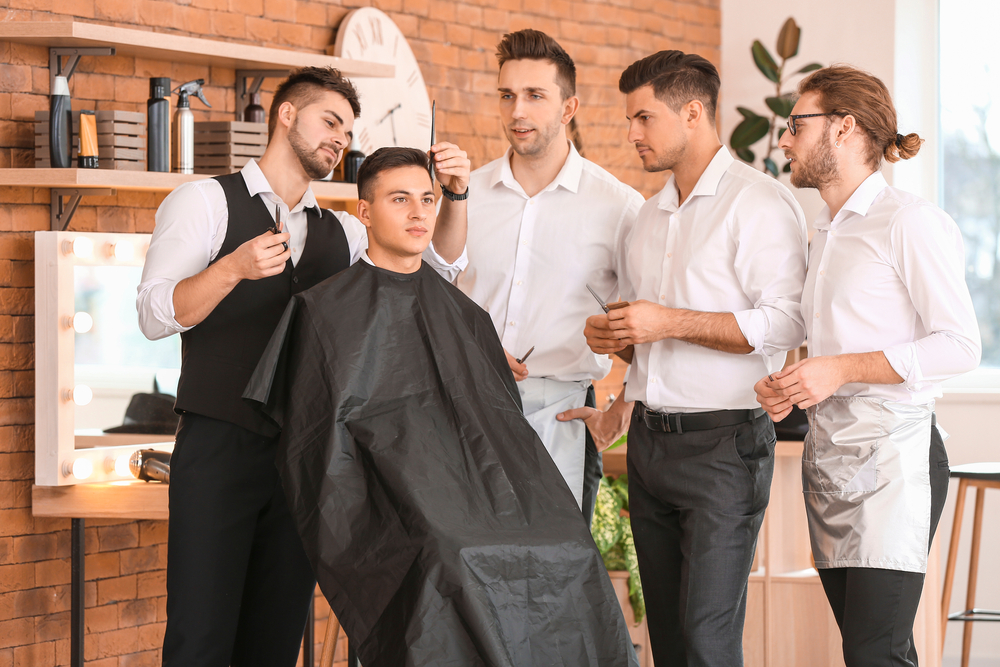
A significant portion of the 1,000 required training hours at Cinta Aveda Institute takes place on a supervised guest floor, where barbering students serve real clients from the San Francisco community — not simulations. Every service is overseen by a licensed instructor, so students get hands-on repetition with actual client consultations, real hair textures, and real feedback, while working toward their state-required hours.
Students can use guest-floor work to document services, practice consultations and product recommendations, and build a portfolio to discuss with potential employers.
From Student Portfolio to Client Book
The transition from barbering school to a paying career is smoothest for graduates who can point to real numbers: how many clients they’ve served, what services they’re confident performing unsupervised, and what a manager or instructor can vouch for. Guest floor training is what makes those numbers possible before a graduate ever applies for their first job.
Frequently Asked Questions
A California barbering school course must include at least 1,000 hours. The Board also recognizes approved apprenticeships and other qualifying routes; candidates must pass the written exam.
Most full-time students complete the required 1,000 hours in about 6 to 12 months, depending on the school’s schedule.
Candidates must pass the California Board’s written licensing exam. A separate practical exam is no longer required.
California barber licenses must be renewed every two years.
Yes. A significant portion of the required 1,000 training hours takes place on a supervised guest floor, where students serve real San Francisco clients under the direct supervision of licensed instructors.
Cinta Aveda Institute offers barbering, cosmetology, and esthetics programs at its San Francisco campus.