
The tuition number catches your attention. The full budget deserves it.
If you are comparing cosmetology tuition in San Francisco, start with what you will actually need to pay for: instruction, your kit, learning materials, required fees, and getting through the school week. A price that looks manageable on a website can feel different when you add your commute and adjust your work schedule.
At Cinta Aveda Institute, the published cosmetology program total is $20,910, including tuition, supplies, and eBooks with an iPad. Below, we break down those charges and show you how to build a personal budget before choosing a start date.
What Cinta Aveda cosmetology tuition includes
Here is the starting point.
As checked on October 7, 2026, our cosmetology program page lists the following costs. Ask admissions for a dated, written quote for your intended class before making your enrollment decision.
| Program charge | Published amount |
|---|---|
| Tuition | $16,765 |
| Supplies kit | $3,545 |
| eBooks and iPad | $600 |
| Registration fee | $0 |
| Total program charges | $20,910 |
The program page separately lists a $75 application fee. California’s cosmetologist examination and initial license application lists a combined $125 fee.
Adding those two fees to the program total produces a planning subtotal of $21,110 before personal expenses or financial aid. This calculation combines school charges with a separate state charge; it is not a school invoice.
Cosmetology tuition versus the complete budget
Think of your budget in three layers. First are charges paid to the school. Second are outside expenses connected with becoming licensed. Third are the everyday costs that allow you to attend consistently.
Keep those layers separate on your worksheet. Otherwise, you might compare one school’s instruction charge with another school’s complete program price and assume they cover the same things.
A useful question is: “What would I still need to buy or pay after covering this quoted amount?” Write down the answer next to the quote.
Questions to ask about your kit
Your kit is a meaningful part of the budget, so ask for its current itemized contents. You should be able to understand what you receive, when you receive it, and which materials you will use during training.
For example, ask whether replacing a lost tool or purchasing optional supplies would create an additional expense. Those are questions to clarify, not extra charges we are assuming you will owe.
Keep the written list with your enrollment paperwork. That gives you something concrete to reference when you prepare for your first week.
Build a Bay Area budget around your school week
Now put the price into your life.
Your personal budget should reflect where you live, how you travel, and the responsibilities you already have. Someone living near campus may have a very different attendance budget from someone commuting from Oakland or the Peninsula.
Start with our housing and transportation resources, then check your own route, travel time, and current fares. Use your actual starting address and the hours you would need to arrive and leave.
Calculate the commute you will actually make
Try the trip during a normal school day before committing to a schedule. A weekend visit can help you find the building, but it may not show you the connections or traffic you will face during the week.
Record the round trip cost, the number of campus days, and any realistic backup expense. If you sometimes need a rideshare after missing a connection, give that possibility a separate line rather than hiding it inside your transit estimate.
The goal is a budget you can explain. Every number should have a source: a fare lookup, a recent receipt, or a clearly labeled assumption.
A sample weekly attendance budget
Here is a hypothetical example, not a Bay Area price estimate or a quote from Cinta Aveda. Imagine a student budgets $40 for weekly transportation, $35 for additional meals, and $25 for a contingency allowance.
| Illustrative weekly expense | Assumed amount |
|---|---|
| Transportation | $40 |
| Additional meals | $35 |
| Contingency allowance | $25 |
| Weekly planning total | $100 |
Over 35 weeks, that assumption adds $3,500. Over 56 weeks, it adds $5,600. Real totals will depend on attendance patterns and spending; an evening student should build a separate estimate rather than reuse a daytime student’s numbers.
Replace every assumption with your own figures. Include childcare or other responsibilities where relevant, and budget for your full living costs across the enrollment period.
Consider how your schedule affects the cost
The calendar matters, too.
Cinta Aveda’s program and scheduling FAQs list a 1,000 hour cosmetology program, with a 35 week daytime option and a 56 week evening option. Review the current attendance requirements and available start dates with admissions.
A shorter schedule may appeal to you if finishing sooner is your priority. An evening schedule may fit better around daytime responsibilities. Neither choice tells us what your employer will allow or how much work you can comfortably maintain.
Make a weekly calendar before deciding. Add class, travel, study time, paid work, and caregiving. Leave room for meals and rest rather than assuming every remaining hour can become a work shift.
Include income changes in your planning
Suppose you currently work weekends and would need to give up one shift for your chosen class schedule. Estimate the take home pay that would disappear, then compare that amount with your available monthly cushion.
This is a personal planning exercise, not an additional tuition charge. Keeping it visible helps you see why the same school price can feel manageable for one student and difficult for another.
Also ask what happens if you need to miss time or change your expected completion date. Get the attendance, makeup, and any applicable additional charge policies in writing before you build a budget around perfect attendance.
How financial aid fits into cosmetology tuition
Here is where the conversation becomes personal.
Our financial aid information describes federal aid options for eligible students, including Pell Grants and Direct Loans. It also lists an interest free payment plan and the FAFSA school code 041800.
Eligibility, award amounts, and payment arrangements vary. Ask the financial aid team to explain your own options and the timing of any money applied to your account.
Grants scholarships and loans serve different purposes
Federal Student Aid describes a scholarship as “a monetary gift that can help you pay for college, career school, or trade school.” Its financial aid dictionary also explains that grants generally do not require repayment, while loans are borrowed money.
When you compare funding options, keep gift aid and borrowing in separate columns. An award letter that includes a loan may help explain how expenses could be paid, but borrowing still creates a repayment obligation.
For example, if a hypothetical student receives a confirmed $2,000 scholarship, that can reduce the amount they need to fund. A $2,000 loan could cover a payment today while creating debt for later. Neither example predicts your eligibility.
Our scholarship resources are a starting point for investigating opportunities. Confirm each award’s current deadline, requirements, and availability before including it in your plan.
Ready to get numbers for your situation? Request your current tuition breakdown and financial aid conversation. Bring your intended schedule and a list of monthly expenses so the discussion addresses your actual budget.
Turn your aid information into a payment plan
Keep going. A submitted application is one step in the process.
Federal Student Aid states, “The financial aid process doesn’t end once you submit your Free Application for Federal Student Aid (FAFSA®) form.” Its guide to next steps after FAFSA explains why reviewing your information and following up matters.
After submitting, review your FAFSA Submission Summary and respond to requests for corrections or documentation. The official summary guide explains that the information helps you understand estimated eligibility and next steps; your school’s aid offer provides the specific award information you need.
Cosmetology tuition payments need dates
Ask for a timeline showing what is due before starting, what is due during school, and when confirmed aid is expected to be applied. A total can be affordable on paper while a particular payment date still creates a problem.
Use three columns: payment date, amount due, and intended funding source. If a source is uncertain, label it pending and work through an alternative with the financial aid team.
For example, do not schedule a tuition payment against a scholarship application that has not produced an award. Keep that possibility separate until you receive confirmation and understand when the funds would arrive.
Check the assumptions behind each monthly amount
If you discuss a payment plan, ask about its duration, initial payment, due dates, and any conditions. Request a written explanation of the terms instead of treating a verbal monthly figure as the complete agreement.
If borrowing is part of your plan, review the loan terms and repayment information with the financial aid team. The question to answer is how the commitment fits your circumstances, including the period after school.
Compare schools using the same cost categories
Make the comparison fair.
Give each San Francisco or Bay Area school the same questions and request written answers. Keep the program name, campus, quote date, and expected schedule at the top of every comparison sheet.
- What are tuition and all required program charges?
- Are the kit, books, and required technology included?
- Which application or licensing expenses are separate?
- What is the expected attendance schedule?
- Which grants or scholarships are confirmed for me?
- What payment dates and borrowing commitments remain?
Our consumer information page provides access to documents you can review alongside your quote. Read the current catalog and applicable enrollment terms, including cancellation and refund information.
When comparing outcomes, ask which program, campus, and reporting period each figure covers. A number without those details gives you less context for judging whether it relates to the education you are considering.
Look beyond the smallest advertised number
Imagine School A shows tuition only, while School B shows tuition plus required materials. Until you itemize both offers, the smaller number tells you very little about their relative cost.
Then consider the experience you want to investigate on a tour: how instruction is organized, how students practice, and how feedback is delivered. Ask specific questions and observe what you can rather than relying on broad promises about your future.
A worked example you can adapt
Let’s put the pieces together.
Consider a hypothetical daytime student using the published program charges and the sample weekly expenses above. This is a planning demonstration, not an actual student’s experience, a financial aid offer, or a prediction of your costs.
The student starts with $20,910 in program charges and adds the $75 school application fee and $125 state application fee. They then add the illustrative $3,500 attendance budget, producing $24,610 before housing, other living expenses, and any aid.
Next, they list expenses already covered by their existing household budget. This prevents counting the same rent payment twice while still making sure rent remains funded throughout school. They separately note any income they expect to lose by reducing work hours.
If that student later receives a confirmed $2,000 scholarship applicable to these costs, the example becomes $22,610 before other expenses and funding. Until the award is confirmed, their baseline remains unchanged.
The useful part is the sequence. You can replace the weekly assumptions, add your own household needs, and see which number changes. Save the worksheet with a date so you can tell whether a later revision came from a new quote, an award, or a change in your plans.
Give every unanswered question an owner
Some answers belong with admissions, such as kit contents and available schedules. Others belong with financial aid, such as award documentation and payment timing. Your employer or household may need to help clarify work hours and shared responsibilities.
Put the person’s name next to each open question, along with the next action and the date you expect to follow up. This keeps an unresolved assumption from quietly becoming a number you rely on.
Revisit the budget before your start date
A useful budget is something you can update. Review it again when you receive your written quote, when your aid information is available, and when your class schedule is confirmed.
For each review, ask what has changed since the last version. Perhaps your commute now needs a second transit connection, your employer has confirmed different shifts, or an award requires another document.
Work through those changes individually. If the numbers leave a gap, identify its size and when it would appear. A $300 shortfall before classes begin calls for a different conversation from a recurring $300 monthly gap.
Bring that specific issue to your next meeting. A clear question gives the team something practical to address and helps you decide whether the proposed start date and schedule fit.
You can bring a trusted family member or friend into this review if that helps. Share the same worksheet so everyone is discussing the same charges, assumptions, and payment dates from the very beginning.
Questions about cosmetology school costs
Is the advertised price my final out of pocket cost?
Not necessarily. Your written program quote, personal expenses, confirmed gift aid, and payment arrangements each affect the amount you need to fund. Build those pieces into one worksheet while keeping loans visible as borrowing.
Should I wait for a scholarship before making a budget?
Create a baseline budget first. Then add confirmed awards as they become available. This lets you see what changes if an application succeeds and what remains unresolved if it does not.
Does evening school automatically cost less overall?
No schedule automatically produces the lowest personal cost. Compare the current school quote, the length of enrollment, commuting patterns, and any changes to your work hours. Use your circumstances rather than assuming someone else’s budget applies.
What should I bring to an admissions meeting?
Bring your preferred start date, a realistic weekly calendar, and your cost worksheet. Include questions about kit contents, payment timing, and any terms you do not understand. Keep copies of the answers with your quote.
Can I plan on earning a specific salary after school?
A school budget should not depend on a promised income that has not been substantiated for your situation. Discuss your career interests, research relevant opportunities, and keep your payment decisions grounded in terms you understand.
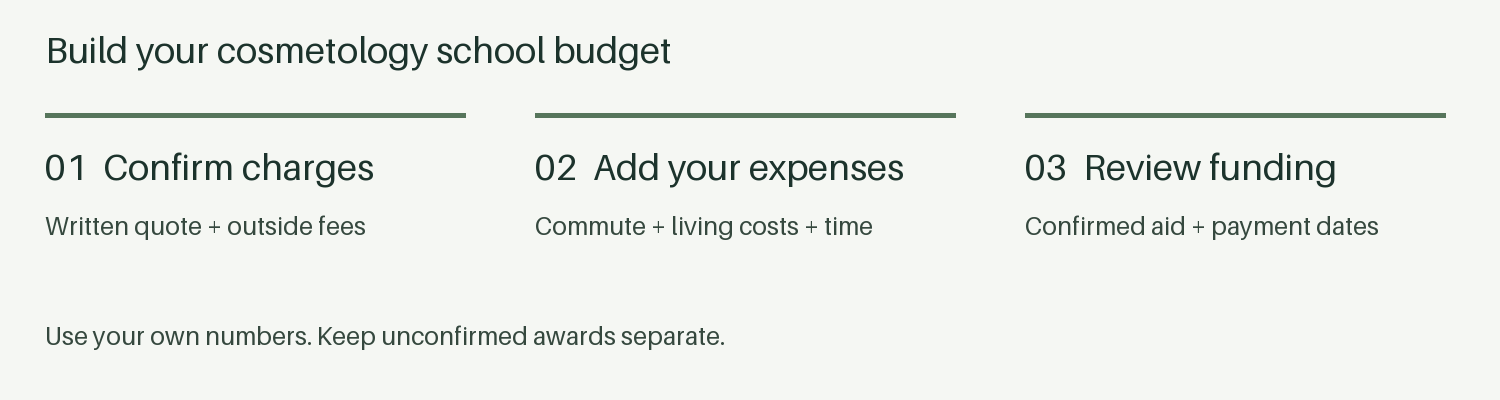
Make your next step a clear one
You do not need to have every answer before starting a conversation. You need a useful set of questions and enough detail to recognize an answer that actually applies to you.
Start with the written program price. Add the separate fees and your personal attendance budget. Then work through confirmed aid, payment timing, and the class schedule you can sustain.
See how the program fits your plans. Book a tour of Cinta Aveda Institute in San Francisco and bring your tuition questions. Use the visit to explore the learning environment and leave with a clear list of the costs and next steps to confirm.